
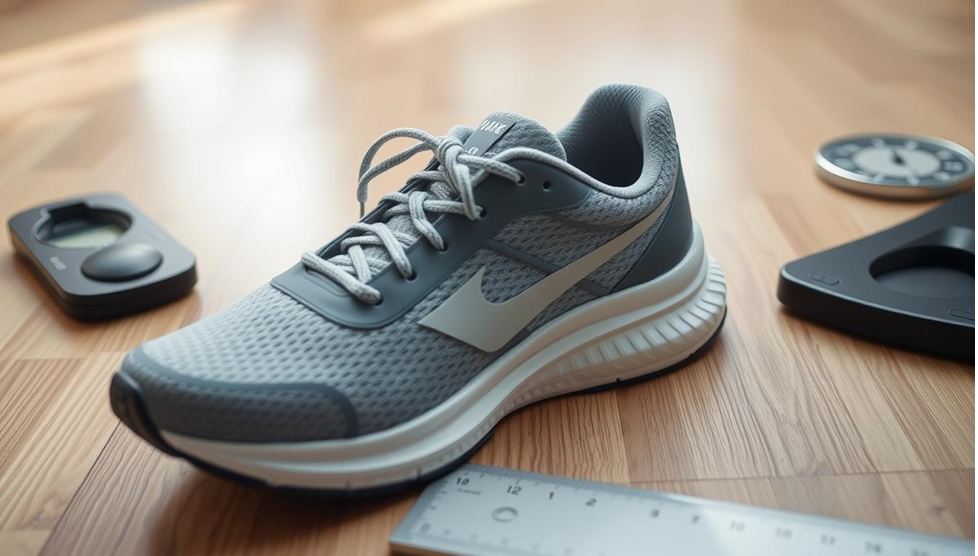
How Should Running Shoes Fit - Get The Perfect Fit
Finding the right fit for your running shoes is key for comfort and avoiding injuries. A good fit should snugly cover your heel and midfoot. Yet, it should also allow your toes to wiggle<>. Remember, running shoes are usually a half size bigger than your everyday shoes<>.
When trying on new shoes, wear the same type of socks you'll wear while running. This helps get a true fit. To check, press your thumb beside the ball of your foot and around your toes<>. You should have a half to a full thumb's width of space<>.
It's worth noting that your shoe size can change. This can happen due to aging, weight gain, or even pregnancy<>. So, it's a good idea to measure your feet every year. This way, you can make sure you're wearing the right size running shoes<>.
Key Takeaways
- Running shoes should be a half size larger than your casual shoes
- Proper fit ensures heel and midfoot snugness with toe wiggle room
- Measure your feet annually as size can change over time
- Test fit by pressing thumb next to ball of foot and around toes
- Wear similar socks when trying on new running shoes
Understanding the Importance of Proper Running Shoe Fit
Finding the right running shoes is key for comfort, performance, and avoiding injuries. Nike running coach Lydia O'Donnell says, ""there is no right or wrong fit, it's all about personal preference and comfort.""<> The right fit can greatly improve your running experience.
Common Problems from Ill-Fitting Shoes
Shoes that don't fit right can cause blisters, bunions, and severe pain. These problems can lead to muscle imbalances and injuries that slow you down<><>.
Impact on Running Performance and Comfort
Wearing the right shoes can boost your running performance and comfort. Nike coach Dave Ridley says the best fit depends on your run type and preference<>. The right fit stops sore feet and discomfort from loose shoes<>.
Why Size Matters in Running Footwear
The size of your running shoes is key for support and comfort. Ridley suggests going up a size for foot changes during running<>. O'Donnell warns against too big shoes, as they can weigh you down and affect your run<>. Finding the right fit is vital for a good running experience.
Tools like the Perfect Fit Finder help find the right shoes. Knowing about materials like mesh for air and foam for cushioning also helps<>.
Understanding your gait and arch type is crucial for choosing the right shoes. Different features are needed for different running styles and foot types<>. Whether training for a race or just running for fun, the right fit keeps you comfortable and safe.
How Should Running Shoes Fit: Essential Guidelines
Getting the right running shoe sizing and proper running shoe fit is key for your performance and comfort. Your shoes should fit snugly in the heel and midfoot, with enough room for your toes to wiggle<>. It's best if there's a thumb's width of space between your longest toe and the shoe's end<>.
Your feet can grow bigger during the day, so measure them at the end of the day<>. Also, go up a full size from your usual shoe size to account for swelling during runs<>. Remember, different shoe models can fit differently, so choose comfort over brand loyalty<>.
- Ensure a snug fit in the heel and midfoot to prevent slippage during strides<>.
- Allow for wiggle room in the toe box to prevent friction and toe injuries<>.
- Use moisture-wicking socks to help reduce blistering<>.
- Consider your specific running gait and foot type when selecting the appropriate shoe<>.
For personalized advice on running shoe sizing and proper running shoe fit , talk to healthcare experts like podiatrists or orthopedists<>.
""A snug fit is suggested for running shoes."" - Peter F. Lovato, DPM, FACFAS<>
Measuring Your Foot Size Correctly
To get the right fit for your running shoes, start by measuring your feet accurately. This guide will show you how to find your perfect shoe size and width. This ensures a comfortable and supportive run.
Step-by-Step Measurement Guide
- Stand on a flat, hard surface with a blank piece of paper on the floor.
- Place your foot on the paper and trace the outline with a pen or pencil<>.
- Measure the length of the tracing from the heel to the longest toe. Use a measuring tape or ruler to get the length in inches or centimeters<>.
- Consult a shoe size conversion chart to determine your running shoe size. It's recommended to choose a shoe that's a half-size larger than your measured foot length to accommodate foot expansion during activity<>.
When to Measure Your Feet
Foot size can change over time due to factors like age, weight fluctuations, and activity levels<>. It's important to measure your feet annually to ensure you're wearing the correct running shoe size<>. Also, measure your feet at the end of the day when they're most swollen for the most accurate size<>.
Understanding Width Measurements
Proper running shoe fit also requires consideration of width. Some individuals may need wider or narrower shoes to achieve the ideal fit<>. Measure the width of your foot at its widest point and refer to a size chart to determine your width<>. Choosing the correct width can help prevent issues like blisters, bunions, and foot pain<>.
""It is recommended to choose a running shoe that is a half size longer than your measured size to accommodate foot lengthening and widening while running.""<>
|------------------------------------------------------------------------------------------------------------------------------------------------------|------------| | Statistic | Source | | Up to two-thirds of people may be wearing shoes that fit improperly. | <> | | Approximately 60-70% of people wear running shoes that are not the correct size, which can lead to various foot-related issues. | <> | | A 2018 study from the Journal of Foot and Ankle Research found that wearing the wrong size shoe is associated with foot pain and poorer foot health. | <> |
The Perfect Heel-to-Toe Fit
Finding the right fit in running shoes is key for comfort and performance. The best fit should snugly hold your heel and midfoot. It should also give your toes enough room to wiggle<>.
To check if the fit is right, press your thumb next to your foot's ball and around your toes. Make sure there's a half to a full thumb's width of space<>. This space lets your foot expand naturally during runs. It also prevents the shoe from feeling too tight or causing blisters.
Also, make sure the heel doesn't move when you hold the shoe's back. This can cause blisters and make you unstable<>.
Look at the eyelet rows on the tongue's sides. They should be almost parallel, not forming a V. This means you might need a longer or wider shoe<>. Use the extra lacing hole for a heel lock to keep your foot in place and prevent slipping.
By paying attention to these fit points, you can make sure your shoes are comfortable and fit well. This helps you perform better and avoid issues like blisters, bruised toes, and heel slippage<><>.
""The right running shoe fit can make all the difference in your performance and comfort on the road or trail.""
Analyzing Your Running Gait and Shoe Requirements
Choosing the right running shoes starts with understanding your running gait. Pronation, where your foot rolls inward, and supination, where it rolls outward, are key<>. Overpronation can cause shin splints and knee pain, while underpronation might lead to ankle injuries and stress fractures<>. A neutral gait is when your foot rolls inward slightly to absorb shock.
Pronation vs Supination Explained
Knowing your pronation type is crucial for picking the right shoes. Overpronators might need stability shoes for extra support, while supinators might prefer neutral, cushioned shoes<>. For overpronators, consider Asics Gel-Kayano, Brooks Adrenaline GTS, and New Balance 860. Underpronators might like Nike Air Zoom Pegasus, Saucony Triumph, and Hoka One One Clifton<>. Runners with a neutral gait can choose Adidas Ultraboost, Mizuno Wave Rider, and New Balance Fresh Foam 1080<>.
Gait Analysis Benefits
A gait analysis can pinpoint your running style and guide you to the right shoes<>. During a gait analysis, you run on a treadmill while cameras and sensors track your foot strike and body alignment<>. Getting a gait analysis can save you money in the long run by preventing injuries and choosing the right shoes from the start<>.
The Wet Foot Test can give a basic idea of your pronation type<>. But, for a precise gait analysis, it's best to see a specialist. Gait analysis sessions usually last about 30 minutes. They can greatly improve your running experience by ensuring you have the right shoe support and traction<>.
Testing Your Running Shoe Fit
Finding the right fit in your running shoes is key for comfort and performance. Begin by walking or running on a treadmill in the shoes<>. This helps check if your heel stays put, if your toes have enough room, and how comfortable they feel. To see if the fit is right, take out the insole and stand on it. Your foot should not go over the edges<>.
Wear your usual running socks when trying on shoes. This can affect how they fit. Testing shoes at the end of the day is also smart, as your feet are usually swollen then<>. This ensures there's no discomfort or tight spots.
A good fit means your heel and midfoot should feel snug, with no slipping<>.
- Make sure there's enough space for your toes, about a thumb's width<><><>.
- Your midfoot and arch should feel supported, with little heel movement<>.
- Think about the type of running you'll do. Racing shoes fit tighter than everyday ones<>.
A well-fitting shoe offers running shoe comfort and boosts your running shoe features and performance. Spend time trying different shoes to find the best fit for your feet.
""A good shoe fit should allow your toes to spread wide, prevent heel slippage, and maintain subtalar neutral angles when standing."" - Running Shoe Expert
By following these steps, you can make sure your running shoes fit perfectly. This supports your feet and makes your runs better<><><>.
Understanding Different Shoe Parts and Their Fit
Running shoes have many parts that work together for comfort and performance. Each part, from the toe box to the heel counter, must fit your foot and running style perfectly.
Toe Box Requirements
The toe box should let your toes spread naturally without feeling tight<>. Materials like Compression-Molded EVA foam make the toe box comfy and strong<>. Thermoplastic Polyurethane (TPU) is durable but can be heavier and firmer than EVA foam<>.
The design of the toe box should give your toes room to move, especially on long runs.
Midfoot and Arch Support
The midfoot area should fit snugly but not too tight, supporting your arch<>. Shoes with dual-density midsoles help prevent overpronation by offering targeted support<>. Materials like Polyether Block Amide (PEBA) foam make shoes responsive and springy<>.
Supercritical foam technology adds to the energy return and makes the shoe lighter.
Heel Counter Fit
The heel counter should keep your heel stable without causing blisters or discomfort<>. Stability shoes often have medial posts made of plastic to reduce overpronation<>. Performance plates, made of carbon fiber or TPU, improve energy return and running efficiency while offering stability and protection.
When picking running shoes, look for options with integrated socks or varied widths for a better fit<>. Many shoes have adjustable lacing holes and heel counters for a secure fit<>. The shoe's last shape and the lasting method used can also affect how it fits.
Finding the right fit is key for a comfortable and efficient run. Knowing how each shoe part works together can help you find the perfect match for your feet and running style.
When to Replace Your Running Shoes
It's important to keep your running shoes in good shape. This is key for your comfort, how well you perform, and avoiding injuries. Generally, you should replace your shoes after about 500 miles<>. But, how often you need to replace them can change based on the shoe's quality, your running style, and where you run<>.
Look out for signs like compressed midsoles, worn outsoles, and upper fabrics that are falling apart<>. Also, if you feel less comfortable or supported, even if you can't see any wear, it's time for new shoes<>. Wearing different pairs of shoes regularly can also make each pair last longer<>.
If you're heavier or taller, or run in a more intense way, you might need to replace shoes more often<>. Keeping your shoes clean and wearing the right socks can also help them last longer<>.
Choosing good-quality materials for your running shoes<> and sticking to a regular replacement schedule is crucial. It ensures your runs stay comfortable and safe from injuries.
""Rotating between multiple pairs of shoes helps in assessing wear and tear on older pairs and allows for drying time, ultimately extending the lifespan of each pair.""
Special Considerations for Different Running Types
Choosing the right running shoes depends on your running type and terrain<>. Road running shoes are best for pavement and tarmac. They offer great cushioning and shock-absorption for your feet and joints<>. Trail running shoes, however, are made for off-road runs. They have better traction, ankle support, and rugged outsoles for uneven surfaces.
The distance you run is also important<>. For marathons or long runs, you need cushioned shoes for support and comfort. Lightweight and race shoes are better for shorter daily runs.
Knowing your running gait is key to picking the right shoes<>. Stability shoes are good for overpronators, while neutral shoes are for underpronators and neutral runners<>. Check your current shoes for wear patterns to see if you're an overpronator, underpronator, or neutral runner.
Brand matters in the running shoe market<>. Different brands offer different levels of comfort, fit, and functionality<>. Experts at Runners Need stores can help you find the right shoe through gait analysis.
Remember, function is more important than fashion<>. It's a good idea to have at least two pairs of running shoes, especially if you've had injuries. This can lower your injury risk by 39%<>. Running shoes last about 500 miles, so keep an eye on their condition.
|------------------------|------------------|-------------------|-------------------------| | Shoe Type | Terrain | Gait Analysis | Distance | | Road Running Shoes | Pavement, Tarmac | Neutral, Stable | Daily, Short | | Trail Running Shoes | Off-Road | Neutral, Stable | Long Distance | | Cushioned Shoes | Pavement, Tarmac | Neutral | Marathon, Long Distance | | Lightweight/Race Shoes | Pavement, Tarmac | Neutral | Daily, Short |
""Runners perform better in shoes that feel the best to them, regardless of other shoe features.""<>
Conclusion
Finding the right running shoe fit is key for comfort and performance. It's important to think about your foot size, how you run, and the shoe's features. Regular measurement and fitting are vital because your foot size can change.
Don't just stick to one brand because it's familiar. Trying different sizes, brands, and models is important for a good fit<>. The right shoes make running better and keep your feet healthy<>.
Finding the right running shoe comfort means understanding how shoes fit<>. Width, cushioning, and traction are all important for a good run. By measuring, analyzing your gait, and trying different shoes, you'll find the perfect pair<>.
The search for the perfect running shoe is a journey of self-discovery. You'll learn about your foot and running needs. Listen to your body and trust your instincts to find the best shoes for you<><><>.
FAQ
How should running shoes fit?
Running shoes should fit snugly in the heel and midfoot. Make sure there's room for your toes to move. Aim for a thumb width of space between your big toe and the shoe.
The heel should stay in place without slipping. The toe box should let your toes spread naturally.
Why is proper running shoe fit important?
The right fit is key for comfort and avoiding injuries. Shoes that don't fit right can cause blisters and pain. This can lead to muscle imbalances and injuries.
Wearing the right shoes can improve your running performance and make it more comfortable.
How do I measure my feet for running shoes?
To measure your feet, use a hard, flat surface and a tape measure. Stand on paper and trace your foot. Then, measure the length and width.
Use a shoe sizing chart to find your size. Remember to measure your feet every year since sizes can change.
How do I know if my running shoes fit properly?
Check the fit by pressing your thumb next to the ball of your foot. There should be half to a full thumb's width of space. Make sure the heel doesn't move when you hold the shoe.
Also, check that the eyelet rows on either side of the tongue are nearly parallel.
How does my running gait affect shoe selection?
Your foot's movement affects shoe choice. Pronation is when your foot rolls inward, and supination is when it rolls outward. Overpronators need stability shoes, while supinators do better with neutral, cushioned shoes.
Gait analysis can help find the right shoe for your running style.
How do I know when to replace my running shoes?
Replace your shoes after about 500 miles. But, this can vary based on shoe quality, running style, and terrain. Look for signs like compressed midsoles and worn outsoles.
Also, check if the upper fabric is deteriorating.
What features should I consider when selecting running shoes?
Think about the running surface and distance. Trail shoes are better for uneven terrain, while road shoes offer more cushioning. For longer runs, choose shoes with more cushioning.
For shorter, faster runs, go for responsive, lightweight shoes.