
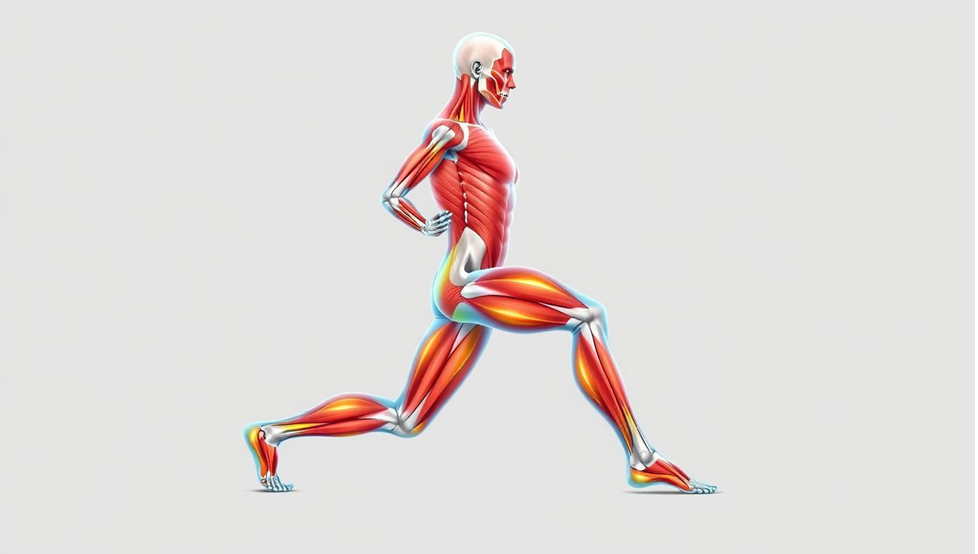
Lunges: Discover the Muscles They Target
Key Takeaways
- Lunges target a variety of leg muscles, including the quadriceps, glutes, hamstrings, and calves.
- The front leg bears more load during a lunge, resulting in greater activation of the glutes and hamstrings.
- Eccentric (lengthening) muscle contractions in lunges are more effective for muscle growth and strength than concentric (shortening) contractions.
- Lunges offer benefits for injury prevention, rehabilitation, and building balanced strength between the legs.
- Incorporating different lunge variations can emphasize specific muscle groups and movement patterns.
Introduction to Lunges
Lunges are a versatile exercise that work many muscles in the lower body. They are key for everyday movements like walking and running. Adding lunges to your workout helps strengthen muscles and boosts balance.
Lunges as a Versatile and Functional Exercise
Lunges target the quadriceps , gluteals , hamstrings , and calves . They offer a full-body workout. Studies show lunges can make athletes stronger and faster, and help in rehab too.
When you do lunges, you step forward or backward with one leg. This makes the movement dynamic and challenges your leg muscles . It also improves balance and stability. Lunges help build strength, power, and coordination for sports and daily activities.
|------------------|-----------------------------------------------------------------------------| | Muscle Group | Role in Lunges | | Quadriceps | Responsible for knee extension, powering the movement | | Gluteals | Engaged in hip extension, stabilizing the pelvis | | Hamstrings | Act as synergists, controlling the descent and assisting in knee flexion | | Calves | Provide ankle plantar flexion, supporting the front leg during the movement | | Core | Stabilize the trunk, maintaining balance and proper form |
Adding lunges to your workout boosts lower body strength, balance, and coordination. They are a great addition to any fitness plan.
Muscle Groups Targeted by Lunges
Lunges work many muscles in the lower body. They focus on the quadriceps, gluteals, and hamstrings. Knowing how these muscles work during lunges helps you train better and get the results you want.
The Quadriceps
The quadriceps are at the front of the thigh. They are the main muscles used in lunges. Research shows lunges work the quadriceps more than squats.
The Gluteals
The gluteal muscles, especially the gluteus maximus, are key in lunges. They help extend the hips and keep the pelvis stable. Using the right lunge form, like leaning forward, boosts glute activation.
The Hamstrings
The hamstrings are at the back of the thigh. They help control the movement and bend the knee. Studies confirm lunges also work the hamstrings a lot.
Knowing which muscles lunges target helps you focus on your fitness goals. You can aim to build strength, boost power, or improve your lower body.
The Mechanics of a Forward Lunge
Lunges are great exercises that work many big muscles. The forward lunge is especially good for balance and core strength. It has two main parts: lowering down and pushing back up.
Eccentric and Concentric Phases
When you lower down in a forward lunge, your leg muscles control the landing. This includes the psoas, biceps femoris, semimembranosus, semitendinosus , and tibialis anterior . Then, when you push back up, your muscles work hard. The gluteus maximus, quadriceps, soleus, gastrocnemius, biceps femoris , and peroneus longus are key here.
It's crucial to do forward lunges correctly to avoid knee problems. This exercise is more challenging than the reverse lunge. To ease knee pain, try a reverse or static lunge instead.
""The forward lunge is the most common variation and likely the first one learned. It's a fantastic exercise for targeting the quadriceps, glutes, and core.""
Benefits of Lunges
Lunges are a versatile exercise that offer many benefits. They help build lower body strength and improve functional fitness. They also help prevent injuries by working multiple muscle groups.
Improved Strength and Injury Prevention
Doing improved strength and injury prevention lunges can make your legs stronger. This includes the quadriceps, gluteals, and hamstrings. This strength boost helps stabilize your knees and hips, lowering injury risk in daily activities and sports.
Unilateral Training and Balance
The unilateral training and balance lunges make each leg work alone. This challenges your stabilizer muscles and spots any muscle imbalances. It improves balance, coordination, and body control, essential for proper exercise form and daily movements.
|---------------------|--------------------------------------------------------------------------------------------------------------------------------| | Benefit | Description | | Improved Strength | Lunges effectively target the quadriceps, gluteals, and hamstrings, leading to significant strength gains in the lower body. | | Injury Prevention | Strengthening the stabilizing muscles around the knees and hips can help reduce the risk of injury during physical activities. | | Unilateral Training | The independent leg movement in lunges challenges your balance and identifies any muscular imbalances between sides. | | Enhanced Balance | Lunges improve overall body control and coordination, which is crucial for maintaining proper form and technique. |
Adding what muscles do lunges work , improved strength and injury prevention lunges , and unilateral training and balance lunges to your routine offers many benefits. These benefits can improve your fitness and functional abilities.
Proper Lunge Technique
Doing lunges right is key to working the right muscles and staying safe. The what muscles do lunges work are the quadriceps, hamstrings, and glutes. This makes lunges a great exercise for everyday movements. To do a proper lunge technique, stand with your feet hip-width apart.
- Step forward with one leg, lowering your body until your front thigh is parallel to the ground.
- Keep your torso upright and your core engaged throughout the movement.
- Push back to the starting position, repeating the same steps with the opposite leg.
Getting the form right is important to get the most out of lunges and avoid injury. Make sure your front knee is in line with your second toe. Don't let your knee go past your toes. Start with one to two sets of 10 to 16 reps per leg. As you get better, you can make it harder.
|--------------------------------------------------------|--------------------------------------------------| | Lunge Technique Tips | Benefits | | Maintain upright torso and engaged core | Improved stability and balance | | Keep front knee in line with second toe | Targeted muscle engagement and injury prevention | | Start with bodyweight, progress to weighted lunges | Increased strength and intensity |
Add lunges to your workout to strengthen your lower body, improve your form, and work specific muscles. With the right lunge technique, you can get the most out of this exercise and boost your fitness.
Variations of Lunges
Lunges are a versatile exercise that can be modified in various ways. They target specific muscle groups or challenge balance and stability. Exploring different lunge variations can add diversity to your lower body workout routine. This ensures well-rounded development.
Static Lunge (Split Squat)
The static lunge, also known as the split squat, emphasizes the quadriceps muscles. This variation is a good option for those with knee concerns. It places less stress on the joint. In a static lunge, you maintain a stationary position with one foot forward and one foot back. You perform the squat motion without stepping forward or backward.
Back Lunge
The back lunge places more emphasis on the glutes and hamstrings . This variation involves stepping back with one leg, lowering your body, and then returning to the starting position. The back lunge can be an effective exercise for building strength and power in the posterior chain muscles.
Lateral Lunge
The lateral lunge engages the adductors (inner thigh muscles) and the medial aspect of the quadriceps. Instead of stepping forward or backward, you step out to the side. Lower your body and then return to the starting position. This variation can help improve hip mobility and balance.
|--------------------------------|------------------------------------| | Lunge Variation | Primary Muscle Groups Targeted | | Static Lunge (Split Squat) | Quadriceps | | Back Lunge | Glutes, Hamstrings | | Lateral Lunge | Adductors, Medial Quadriceps |
Incorporating these lunge variations into your workout routine can help you target different muscle groups. It improves overall lower body strength and enhances your athletic performance.
what muscles do lunges work
Lunges are a versatile exercise that work many muscles in the lower body. The main muscles targeted are the quadriceps , gluteals , and hamstrings.
The quadriceps are on the front of the thigh. They are key in extending the knee during lunges. This helps in pushing through the movement.
The gluteal muscles, especially the gluteus maximus, extend the hips and keep the pelvis stable. They are vital for power and control in the lunge.
The hamstrings are on the back of the thigh. They help control knee bending and assist in hip extension during lunges.
Lunges also work the calf muscles , core musculature , and hip flexors. The calf muscles help stabilize the lunge. The core muscles, like the abdominals and back, keep the torso stable. The hip flexors stretch, improving mobility and flexibility.
|------------------|---------------------------------------------------| | Muscle Group | Role in Lunges | | Quadriceps | Primary movers responsible for knee extension | | Gluteals | Extend the hips and stabilize the pelvis | | Hamstrings | Control knee flexion and assist in hip extension | | Calves | Provide stability and support during the movement | | Core | Stabilize the torso and maintain proper form | | Hip Flexors | Stretched during the lunge, improving mobility |
Lunges are great for strengthening the lower body. They improve athletic performance and daily movement. This makes them a valuable exercise.
Lunges vs. Split Squats
Lunges and split squats both work the lower body, but they differ. Lunges are dynamic, improving strength and balance. Split squats focus on balance and stability in a stationary position.
Choosing between lunges and split squats depends on your goals. Lunges boost lower body power and leg strength. They work muscles in a varied way. Split squats are great for heavy lifting and building muscle, especially in the quads.
Key Differences:
- Movement pattern: Lunges involve a stepping motion, while split squats are a stationary exercise.
- Balance and stability: Lunges require greater balance and stability due to the dynamic nature of the movement, while split squats are more stable.
- Muscle activation: Lunges engage the whole lower body, including the quadriceps, glutes, and hamstrings, while split squats primarily target the quadriceps.
- Power development: Lunges are more effective for improving overall lower body power, while split squats are better for developing muscle strength and hypertrophy.
Both lunges vs. split squats are great for the lower body. Your choice depends on your fitness goals and preferences. Mixing both in your workout helps develop a balanced lower body.
Incorporating Lunges into Your Routine
Lunges are a key exercise for a strong workout routine. They work many muscles at once, making them great for fitness. Adding lunges to your routine can really change your workout.
Lunges are great for strengthening your lower body. They work your quadriceps, glutes, and hamstrings. This helps you with everyday activities like walking and climbing stairs.
Lunges also improve your balance and stability. They help you stay steady by working one leg at a time. This can help prevent falls and boost your physical performance.
Moreover, lunges help loosen up your hips. They let your hip muscles move fully. This can help with any tightness or stiffness in your hips.
To start, try simple lunges like forward or reverse lunges. As you get better, try more challenging ones like lateral or walking lunges. Always focus on proper form to get the most benefits and avoid injuries.
Lunges are great for building strength, improving balance, and boosting flexibility. Adding them to your routine can help you reach your fitness goals. With regular lunges, you'll see many benefits and enjoy your workouts more.
|---------------------|--------------------------------|-------------------------------------------------------------| | Lunge Variation | Targeted Muscles | Benefits | | Forward Lunge | Quadriceps, Glutes, Hamstrings | Improves overall lower body strength and balance | | Reverse Lunge | Quadriceps, Glutes, Hamstrings | Emphasizes eccentric muscle control and balance | | Lateral Lunge | Adductors, Abductors, Glutes | Enhances hip and lateral leg mobility | | Walking Lunge | Quadriceps, Glutes, Hamstrings | Develops functional, multi-planar strength and coordination |
Remember, what muscles do lunges work and incorporating lunges into your routine are key for fitness goals. They help improve lower body strength, balance, and flexibility.
Advanced Lunge Variations
If you want to level up your lunge game, there are advanced options. These can push your muscles harder, boost power, and keep you improving. They offer a new challenge for your workouts.
Weighted Lunges
Weighted lunges add dumbbells or kettlebells to your lunge routine. This extra weight makes your quadriceps , gluteals , and hamstrings work harder. It helps build strength and muscle.
It's key to keep the right form when doing weighted lunges. This helps prevent injuries and keeps you balanced.
Jumping Lunges
Jumping lunges add a powerful jump to your lunge. This jump uses your back leg to lift you up and forward. It's great for boosting your what muscles do lunges work and jumping ability.
Start with caution and focus on proper form when trying these advanced lunges. If you're new, it's wise to get advice from a fitness expert.
Adding weighted lunges and jumping lunges to your routine can elevate your lunge training. They offer exciting and effective ways to challenge your what muscles do lunges work.
Conclusion
Lunges are a great exercise for the lower body. They work the quadriceps , gluteals , and hamstrings. They help build strength, improve balance, and get ready for daily activities and sports.
Lunges are essential for a strong lower body. They are great for a workout focused on the legs. They also work other muscles, making them a full-body exercise.
Learning the right lunge technique and trying different types can make lunges very effective. They help make the lower body stronger and more balanced. Adding lunges to your workout routine can help you reach your fitness goals and stay healthy.
FAQ
What muscles do lunges work?
Lunges mainly work the muscles in your lower body. This includes the quadriceps, gluteals, and hamstrings. The quadriceps help extend your knees.
The gluteal muscles, especially the gluteus maximus, help extend your hips and keep your pelvis stable. The hamstrings help control your descent and assist in knee flexion. The calf muscles, core, and hip flexors also play a role in stability and support.
What is the difference between lunges and split squats?
Lunges and split squats both work the lower body muscles. But, they differ in how they work these muscles. Lunges are a dynamic movement that improves reactive strength and balance.
Split squats, on the other hand, are a stationary exercise that focuses on balance and stability. Your choice between lunges and split squats depends on your fitness goals. Lunges are great for improving lower body power, while split squats are better for heavier load training.
What are some advanced lunge variations?
If you're looking to challenge yourself more, there are advanced lunge variations. Weighted lunges use dumbbells or kettlebells to increase resistance. Jumping lunges add a plyometric component to enhance power and explosiveness.
These advanced variations should be done with caution and proper form to avoid injury. It's wise to consult a qualified fitness professional before trying them.
Source Links
- What Muscles Do Lunges Work? - https://www.healthline.com/health/fitness-exercise/lunges-muscles-worked
- What Muscles Do Lunges Work? An Exercise Physiologist Explains - https://www.nike.com/a/what-do-lunges-work
- Lunges: Benefits and Recommended Variations - https://www.hingehealth.com/resources/articles/lunge/
- NSCA Personal Trainer Quarterly | 4.4 - https://www.nsca.com/contentassets/24dd7222ed1b4caeb8a0a46b81bd11f3/ptq-4.4.9-the-undervalued-lunge.pdf?srsltid=AfmBOoonSbO8G33JQZy5ADgNdO6zmDQ-ELSoYYd3sBYOZlJ2-rRSiK-o
- How to Lunge: A Complete Guide | Muscle and Motion BLOG - https://www.muscleandmotion.com/how-to-do-lunges-a-complete-guide/
- Benefits of Lunges: 11 Benefits, Types, and More - https://www.healthline.com/health/exercise-fitness/lunges-benefits
- How to Properly Engage Muscles When Lunging - https://www.verywellhealth.com/lunges-muscles-worked-8677824
- These Simple Tweaks Help Lunges Target Your Quads, Glutes or Inner Thighs | Livestrong.com - https://www.livestrong.com/article/439335-what-muscles-do-lunges-work-out/
- Forward Lunge Vs Reverse Lunge: What's The Difference? - https://sweat.com/blogs/fitness/forward-vs-reverse-lunges
- The Forward vs. The Reverse Lunge - https://drjohnrusin.com/pain-free-lunging-the-forward-vs-reverse-lunge/
- Lunges Muscles Worked, Variations, And Benefits - https://betterme.world/articles/lunges-muscles-worked/
- 11 Benefits of Doing Lunges Regularly - Evergreen Rehab & Wellness - https://evergreenclinic.ca/11-benefits-of-doing-lunges-regularly/
- How to Do a Lunge and Why They're So Good for You - https://www.everydayhealth.com/fitness/how-to-do-a-lunge-and-why-theyre-so-good-for-you/
- Walking Lunges Are a Staple Functional Fitness Move---Here's How to Master Them - https://www.onepeloton.com/blog/how-to-do-walking-lunge/
- How to Lunge: Techniques, Benefits, Variations - https://www.verywellfit.com/how-to-lunge-variations-modifications-and-mistakes-1231320
- How to Do a Lunge with Perfect Form - https://www.onepeloton.com/blog/how-to-do-lunges/
- All About Lunges: 13 of the Best Variations - https://www.beachbodyondemand.com/blog/lunges-exercise-workout
- What Muscles Do Lunges Work | Garage Gym Reviews - https://www.garagegymreviews.com/what-muscles-do-lunges-work
- Reverse Lunges: Tips and Recommended Variations - https://www.hingehealth.com/resources/articles/reverse-lunges/
- How to Do Side Lunges---Work Your Quads, Hamstrings, & Glutes | ISSA - https://www.issaonline.com/blog/post/how-to-do-side-lunges-work-your-quads-hamstrings-glutes
- The Differences Between the Lunge Vs. Split Squat Explained | BarBend - https://barbend.com/lunge-vs-split-squat/
- Split Squat vs Lunge: Which Exercise is Best for You? - https://homegymsupply.co.uk/blogs/guides/split-squat-vs-lunge?srsltid=AfmBOorrSHebv0mpIQXQrb-BG2RqwPwIIjAZrN9poHpQrm5grcoJjVno
- Split Squat vs Lunge: An Expert Explains the Difference | Garage Gym Reviews - https://www.garagegymreviews.com/split-squat-vs-lunge
- Unlocking the Benefits: Why Lunges Should Be a Staple in Your Workout Routine | BPS Tensegrity - https://bpstensegrity.au/unlocking-the-benefits-why-lunges-should-be-a-staple-in-your-workout-routine/
- 4 Benefits of Lunges That Go Beyond a Sculpted Backside - https://www.wellandgood.com/benefits-of-lunges/
- 18 Lunge Variations That Will Work Your Butt From Every Angle - https://www.self.com/gallery/lunge-variations
- Why You Need to Switch Up Your Leg Day with More Lunge Variations - https://www.onepeloton.com/blog/lunge-variations/
- Lunge Directions - Forwards, Backwards, Sideways, Rotational - https://theprehabguys.com/lunge-directions/
- What Muscles Do Side Lunges Work? Leg Day Training - https://speede.fit/blogs/news/what-muscles-do-side-lunges-work?srsltid=AfmBOop4ODh9au6G3uPz1bRkXrP2SSps3Lgf0ct0Vd83wo9lXrnizECY
- 7 Awesome Benefits of Lunges (Build Incredible Power, Muscle and Glutes!) | BOXROX - https://www.boxrox.com/benefits-of-lunges/