
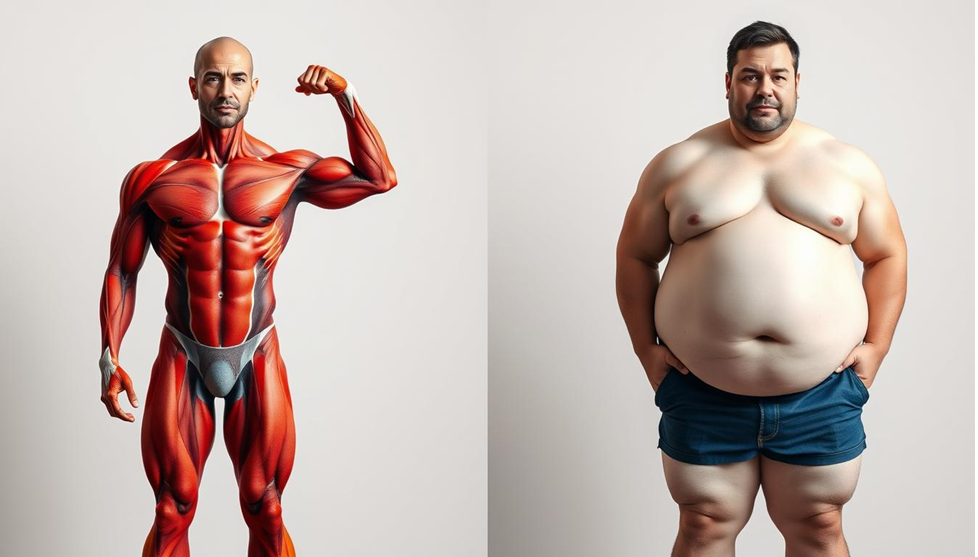
Muscle vs. Fat: Understanding Weight Differences
Checking muscle and fat levels is better than just watching your weight<>. This approach helps set personal fitness goals and supports health journeys without comparing to others.
Key Takeaways
- Muscle and fat weigh the same but differ significantly in density.
- Body fat percentage helps in determining a person's tone and fitness appearance.
- Increasing muscle mass can boost metabolism and calorie burning.
- Monitoring muscle and fat composition provides reliable health indicators.
- Balancing muscle gain and fat loss is key to achieving a fit physique.
Understanding Muscle and Fat: The Basics
Muscle and fat are key parts of our body's make-up, each playing unique roles for our health. Knowing the differences between muscle and fat is key for managing our health well.
Functions of Muscle Tissue
Muscle tissue helps us move, keep our posture, and aids in many metabolic processes. A pound of muscle burns about 7 additional calories daily, way more than a pound of fat, which only burns 2 calories per pound<>. So, having more muscle means a faster metabolism, which is good for our health.
Functions of Fat Tissue
Fat tissue does a lot, like storing energy, keeping us warm, and helping with hormone balance. But too much fat can be a big health risk. Studies show that those with more body fat tend to live shorter lives, even if they're not overweight<>. Finding the right balance between muscle and fat is key for staying healthy.
Importance of Body Composition
Our body composition tells us more about our health than just our weight. Having the right mix of lean body mass and body fat affects how well we perform physically and our overall health. Eating a diet high in protein helps keep muscle while losing fat, especially when we exercise a lot<>.
https://youtube.com/watch?v=tk-ZD6P0U-U
|---------------|-------------------------------|----------------------------------------------------| | Component | Calories Burned per Pound | Health Implications | | Muscle | 7 calories | Supports metabolism, reduces risk of health issues | | Fat | 2 calories | Excess can lead to health complications |
Does Muscle Weigh More Than Fat?
Many think muscle weighs more than fat, but this isn't true. Both muscle and fat have the same weight when measured pound for pound. However, muscle is denser and can take up to 18% less space in the body<>. This fact is key to understanding body composition and the muscle to fat ratio.
The Weight of Muscle and Fat Explained
When we look at muscle vs fat weight, their density matters. Losing five pounds of fat might not change your weight on the scale but can improve your body composition <>. You might look slimmer or more toned, even if your weight stays the same. Adding muscle through strength training and eating well helps with fat loss and better body composition<>.
Impact of Density on Body Composition
Because muscle is denser than fat, people with more muscle can look leaner and fitter, even if they weigh the same as others with more fat. This can make it hard to see progress when trying to get fit. It's better to focus on building strength and losing fat than just watching the scale<><>. Using waist size and body fat percentage gives a clearer picture of health, showing the limits of BMI which doesn't consider muscle<>.
|-----------------------------|-----------------------------|-------------------------------| | Property | Muscle | Fat | | Density | Higher Density | Lower Density | | Space Occupied | Less Space (up to 18% less) | More Space | | Metabolic Rate Contribution | Higher metabolism | Lower metabolism | | Health Implications | Less body fat | Higher risk for health issues |
Muscle Density vs Fat Density: What You Should Know
Knowing the difference between muscle and fat density is key for those looking to improve their body shape. Muscle is denser than fat, taking up less space for the same weight. This makes it easier to look leaner and firmer. This fact is very important for your health.
Comparing Volume and Weight
Muscle and fat take up different amounts of space even when they weigh the same. For example, the American Council on Exercise says men should have 14% to 24% body fat, and women 21% to 31% <>. Having too much fat can lead to serious health problems like diabetes and heart disease<>. Muscle also helps you burn calories even when you're not moving, which is good for your health<>.
Health Implications of Body Composition
Having more body fat can increase your risk of dying early, even if you're not overweight or obese<>. Having more muscle mass is good for your health and well-being. Doing strength training and activities like yoga can help build muscle and improve your body shape. It's best to do strength training 3 to 4 times a week and eat a lot of lean protein to help your muscles grow<>.
Muscle also helps keep your metabolism up, supports healthy aging, and helps control blood sugar levels<>. As you get older, you start losing muscle mass, which is called sarcopenia, around 30 or 35. The CDC suggests doing resistance training and cardio to fight this<>. Knowing how your body composition affects your health is important for making good choices.
How to Measure Muscle Mass vs Fat Mass
Measuring muscle and fat mass is more than just weighing yourself. It's key to understanding your health and fitness. There are several methods to do this, including:
Understanding Body Composition Analysis Techniques
- Dual-energy X-ray absorptiometry (DEXA): This is the top choice for measuring body composition. It gives precise info on bone density and fat mass.
- Bioelectrical impedance analysis (BIA): This method uses weak electrical currents to estimate body composition. It's good for tracking changes over time.
- Skin calipers: They help measure skinfold thickness to estimate body fat. But, how well you use them matters.
- Air displacement (body pod): This technique figures out body density to find out fat mass.
- Underwater weighing: This method uses buoyancy to estimate body fat.
The Role of BMI in Understanding Weight
The Body Mass Index (BMI) is a useful tool. It looks at your height and weight to put you into categories. These categories are:
|----------------|----------------| | Category | BMI Range | | Underweight | Below 18.5 | | Healthy weight | 18.5-24.9 | | Overweight | 25.0-29.9 | | Obesity | 30.0 and above |
BMI tells you if you're in these categories, but it doesn't tell you about muscle or fat distribution. Using body composition analysis along with BMI gives a fuller picture of your health. This approach is key for making good health plans<><><>.
Conclusion
Knowing the difference between muscle and fat is key for better health and fitness. Many think muscle weighs more than fat, but they actually have the same weight per pound. Yet, they play different roles in our bodies and affect our health in unique ways. For example, muscle burns more calories even when we're not moving, helping us stay at a healthy weight<>.
To get a better body composition, mix weight training, a balanced diet, and regular exercise. These steps not only make you look better but also boost your health. Remember, BMI isn't always a reliable measure, especially for those with a lot of muscle<>. Focusing on body composition rather than just weight gives a clearer picture of your health.
On your fitness path, keep an eye on your body composition for a better health picture. Having more muscle can really boost your metabolism, helping you keep a healthy weight<> and enhancing your life quality. Aim to build lean muscle and understand fat's role to meet your fitness goals.
FAQ
Does muscle weigh more than fat?
No, a pound of muscle and a pound of fat both weigh the same. But muscle is denser than fat. This means muscle takes up less space in your body.
What is the difference between muscle weight vs fat weight?
The main difference is in their density. Muscle is denser and takes up less space than the same weight of fat. So, someone with more muscle might look slimmer and more toned at the same weight.
How does muscle density vs fat density affect body composition?
Muscle density helps you burn calories faster because muscle is active. Fat doesn't burn calories like muscle does. Knowing this helps you work on your body composition.
What does pound for pound muscle vs fat mean?
""Pound for pound"" means comparing muscle and fat at the same weight. Even though they weigh the same, muscle takes up less space. This affects how you look and your metabolic health.
How can I improve my muscle to fat ratio?
Improve your muscle to fat ratio by doing regular weight training. Focus on building lean muscle and eating a balanced diet to support your fitness goals.
What is the importance of body composition analysis?
Body composition analysis shows how much muscle and fat you have in your body. It gives a clearer picture of your health than just your weight.
What techniques can be used for measuring muscle mass vs fat mass?
You can use techniques like dual-energy X-ray absorptiometry (DEXA) and bioelectrical impedance analysis to measure your muscle and fat levels. These methods give you insights into your body composition.
How does the role of BMI fit into understanding weight?
BMI gives a general idea of your body weight. But it doesn't tell the difference between muscle and fat. Using BMI along with other body composition measures gives a clearer view of your health.
Source Links
- Muscle density vs Fat: how it affects your weight | Tanita.eu - https://tanita.eu/blog/muscle-density-vs-fat
- Does Muscle Weigh More Than Fat? | Juniper - https://www.myjuniper.com/blog/does-muscle-weigh-more-than-fat?srsltid=AfmBOoo1_CYSVrqrD5lvnniLPklxZGHu5f3JxJ9_BT3iuio-yeOPd-kE
- Body Recomposition: Lose Fat and Gain Muscle at the Same Time - https://www.healthline.com/nutrition/body-recomposition
- Does Muscle Weigh More Than Fat? 5 Reasons to Ditch the Scale - https://www.trifectanutrition.com/blog/does-muscle-weigh-more-than-fat-5-reasons-to-ditch-the-scale?srsltid=AfmBOorJmVK0sOkFXxea3puhgOTv4N0u_kkIfpkNj6dfw5w0h6PhgZPp
- Podcast Episode 118: Does Muscle Really Weigh More Than Fat? | Exercise Coach - https://exercisecoach.com/podcast-episode-118-does-muscle-really-weigh-more-than-fat/
- Does Muscle Weigh More Than Fat? - https://greatist.com/fitness/does-muscle-weigh-more-fat
- The Difference Between Muscle vs. Fat Weight - https://health.clevelandclinic.org/muscle-vs-fat-weight
- Does Muscle Weigh More Than Fat? The Truth About Body Composition - https://www.healthline.com/health/does-muscle-weigh-more-than-fat
- True or False: Muscle Weighs More Than Fat - https://www.health.com/fitness/does-muscle-weigh-more-than-fat
- What Is Body Composition? - https://www.webmd.com/fitness-exercise/what-is-body-composition
- Muscle Mass Percentage Averages and How to Calculate It - https://www.healthline.com/health/muscle-mass-percentage
- Understanding your body composition scale measurements - Marsden - https://www.marsden-weighing.co.uk/blog/body-composition-scale-measurements?srsltid=AfmBOoo5VM_-0gkYISylDnpZb1jAVgv2dVrdgSBwOX0VXxJhXKOjPOiD
- Muscle vs. Fat: Unveiling the Truth about Weight - https://www.bodyspec.com/blog/post/muscle_vs_fat_unveiling_the_truth_about_weight
Letter to the Editor Response - https://www.ncbi.nlm.nih.gov/pmc/articles/PMC3445228/