
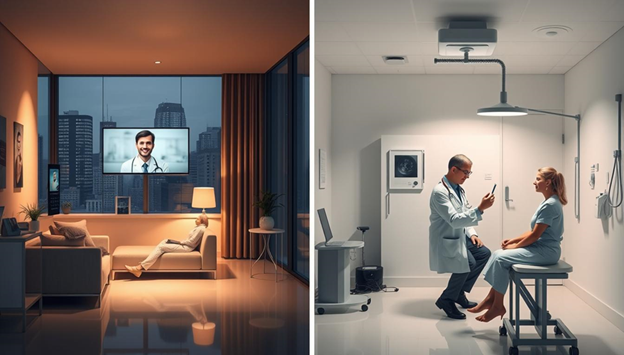
Telehealth vs In-Person Visits: Our Comprehensive Comparison
The way people receive health care has changed dramatically in recent years. The debate between telemedicine and traditional visits has grown, especially after the COVID-19 pandemic. Many Americans turned to virtual options for safety and convenience, and 40% plan to continue using them even after the pandemic.
A study from Northwestern University found that 76% of patients were satisfied with their telemedicine experiences. This highlights its potential to provide quality care while improving access for those in remote or underserved areas.
This article will explore key factors like convenience, safety, cost, and quality of care. It will also discuss insurance coverage and the rise of hybrid care models, blending telemedicine with in-person services.
Introduction to Telehealth and In-Person Visits
Modern technology has reshaped how patients connect with their healthcare providers. The introduction of telemedicine has brought a new dimension to medical care, offering flexibility and accessibility like never before.
What is Telehealth?
Telemedicine refers to the remote diagnosis and treatment of medical conditions using secure digital platforms. It allows patients to consult with doctors via computers, tablets, or smartphones. This approach is particularly useful for follow-ups, mental health services, and managing chronic conditions.
Before the pandemic, only 8% of Americans had used telemedicine . By 2021, that number jumped to 33%, highlighting its growing acceptance. This shift has made care more accessible, especially for those in remote or underserved areas.
What are In-Person Visits?
Traditional in-person visits require patients to physically visit a healthcare facility. These appointments often involve hands-on examinations, diagnostic tests, and face-to-face interactions with providers. While they remain essential for certain conditions, they can be less convenient for routine check-ups.
The key difference lies in the approach. Telemedicine relies on technology, while in-person visits depend on physical presence. Both methods have their unique advantages, making them complementary rather than mutually exclusive.
The Rise of Telehealth During the COVID-19 Pandemic
The COVID-19 pandemic transformed healthcare delivery in unprecedented ways. As the virus spread, the need for safe and efficient care became critical. This led to a rapid shift from traditional methods to digital solutions, reshaping how patients interacted with their providers.
Impact of COVID-19 on Healthcare Delivery
In March 2020, the CDC expanded emergency telehealth services to meet the growing demand. This allowed patients to access care without risking exposure. By the peak of the pandemic, over 70% of providers had adopted telemedicine, compared to less than 10% before the crisis.
A study by the AHRQ revealed that 31.3% of telemedicine visits were conducted via telephone, while 19.5% used video platforms. This flexibility ensured that even those without advanced technology could receive care. The fear of infection drove 76% of patients to express satisfaction with remote services.
Shift from In-Person to Telehealth Visits
Healthcare providers faced challenges in implementing technology quickly. Many had to adapt to new systems and train staff in a short time. Despite these hurdles, the transition proved successful. In 2021, 50.8% of 2.3 million primary care visits were conducted virtually.
Interestingly, the return rate for telemedicine was 7.6%, compared to just 1.3% for in-person appointments. This suggests that remote care not only met immediate needs but also encouraged follow-ups. The pandemic highlighted the potential of telemedicine to complement traditional care.
|----------------|-----------------| | Visit Type | Return Rate | | Telemedicine | 7.6% | | In-Person | 1.3% |
The pandemic underscored the importance of a flexible healthcare system. It also paved the way for hybrid models, blending digital and in-person care. As the world recovers, the lessons learned during this time will continue to shape the future of medicine.
Telehealth vs In-Person Visits: Key Differences
Understanding the differences between remote and traditional care can help patients make informed decisions. Both methods have unique advantages, but they cater to different needs and preferences. This section explores accessibility, convenience, quality of care, and patient-provider interaction to provide a clear comparison.
Accessibility and Convenience
Remote care eliminates travel time, making it a convenient option for many. Immediate virtual appointments reduce wait times, which can be as long as 20 minutes for in-person visits. This is especially beneficial for those in rural or underserved areas, where access to healthcare facilities may be limited.
However, remote care has its limitations. Diagnostic tests and hands-on examinations are not possible, which can affect the accuracy of certain treatments. Despite this, 63% of patients and 60% of doctors rate remote care as equally effective for many conditions.
Quality of Care
The quality of care remains a critical factor in choosing between remote and traditional methods. Studies show that prescription rates are slightly higher for in-person visits (46.8%) compared to video consultations (38.4%). This highlights the importance of physical examinations in certain cases.
Interestingly, Northwestern University found that Black patient satisfaction increased by 33% with remote care. This suggests that telemedicine can address disparities and improve outcomes for underserved communities.
Patient-Provider Interaction
Building strong relationships with providers is easier in person. Face-to-face interactions foster trust and allow for more personalized care. In virtual settings, relationship-building can be challenging due to the lack of physical presence.
Despite this, the Net Promoter Score for remote care is 93%, compared to 89.1% for in-person visits. This indicates that many patients value the convenience and efficiency of digital consultations.
Advantages of Telehealth
Digital health solutions offer unparalleled benefits for modern patients. From saving time to enhancing safety, remote care has transformed how people access medical services. Below, we explore the key advantages that make telehealth a preferred choice for many.
Convenience and Time-Saving
One of the biggest perks of telehealth is its convenience. Patients can consult doctors from the comfort of their home, eliminating the need for travel. On average, this saves 94 minutes per appointment, making it ideal for busy schedules.
Additionally, 59% of providers report reduced no-show rates with telehealth. This ensures that patients stay on track with their care plans, improving overall health outcomes.
Comfort and Safety
Remote care minimizes exposure to infections, especially for immunocompromised individuals. This added layer of safety has made telehealth a trusted option during flu seasons and pandemics.
For rural patients, telehealth offers 24/7 access to specialists they might not have locally. This bridges the gap in healthcare access, ensuring everyone receives timely care.
Cost-Effectiveness
Telehealth can also save money. Virtual chronic condition management costs 20% less than traditional methods. This makes it a budget-friendly option for long-term care.
Insurance plans are also adapting. Currently, 31% of plans waive copays for telehealth visits, making it more affordable for patients.
- Eliminates 94 minutes of travel time per visit.
- Reduces infection risks for vulnerable patients.
- Offers 24/7 access to specialists in rural areas.
- Lowers costs for chronic condition management by 20%.
- 31% of insurance plans waive copays for telehealth visits.
Disadvantages of Telehealth
While digital health solutions have many benefits, they also come with certain challenges. Understanding these drawbacks can help patients make informed decisions about their care. Below, we explore the key limitations of remote medical services.
Limitations in Physical Examinations
One of the biggest challenges of remote care is the inability to perform hands-on examinations. Conditions like chest pain or neurological issues often require in-person diagnosis. Without physical assessments, providers may miss critical details, leading to less accurate treatment plans.
Studies show that antibiotic prescribing rates are 43% lower via virtual consultations. While this can reduce overprescribing, it also highlights the limitations in diagnosing certain conditions remotely.
Privacy and Security Concerns
Protecting patient information is a top priority in healthcare. While HIPAA-compliant platforms are required, hacking risks remain a concern. Patients must ensure their devices and internet connections are secure to safeguard their data.
Despite these measures, 5.5% of patients express dissatisfaction with remote care, slightly lower than the 5.8% for in-person visits. This suggests that privacy concerns, while valid, are not a major deterrent for most users.
Technology Requirements
Access to reliable technology is essential for virtual consultations. However, 12% of patients lack the required broadband, and 23% of seniors do not have video-capable devices. This digital divide can limit access for vulnerable populations.
Additionally, navigating digital platforms can be challenging for some users. Providers must ensure their systems are user-friendly to accommodate all patients.
- Hands-on examinations are not possible, affecting diagnosis
- HIPAA-compliant platforms are required, but hacking risks persist.
- 12% of patients lack broadband, and 23% of seniors lack video-capable devices.
- Antibiotic prescribing rates are 43% lower via virtual consultations.
- 5% dissatisfaction rate for remote care vs. 5.8% for in-person visits.
Advantages of In-Person Visits
Traditional healthcare methods remain a cornerstone of medical care for many patients. While digital options have grown in popularity, in-person visits offer unique benefits that cannot be replicated virtually. These include thorough physical examinations, stronger connections with providers, and immediate access to essential tests.
Comprehensive Physical Examinations
One of the most significant advantages of in-person visits is the ability to conduct hands-on examinations. For example, abdominal exams have a 98% accuracy rate when performed in person, compared to just 72% virtually. This precision is crucial for diagnosing complex conditions and ensuring effective treatment plans.
Essential diagnostics like X-rays, blood draws, and biopsies are also more accessible during in-person visits. These tests often require specialized equipment and trained staff, which are readily available in healthcare facilities.
Stronger Patient-Provider Relationships
Face-to-face interactions foster trust and understanding between patients and providers. Non-verbal communication, such as body language and eye contact, plays a significant role in building rapport. Studies show that 38% more trust is established during in-person visits compared to virtual consultations.
This stronger relationship can lead to better care outcomes. For instance, new patient satisfaction is 11.8% higher in person, and referrals for complex cases are 2.1 times faster.
Immediate Access to Diagnostic Tests
In-person visits allow for immediate access to diagnostic tools and imaging services. This is particularly important for urgent conditions that require quick diagnosis and treatment. Imaging orders, such as MRIs or CT scans, are 47% higher during in-person visits, ensuring timely and accurate care.
Additionally, patients often feel more confident in their diagnosis when tests are conducted on-site. This reduces the likelihood of follow-up visits and ensures a smoother healthcare experience.
- Hands-on exams achieve 98% accuracy for abdominal conditions.
- Non-verbal communication builds 38% more trust in person.
- Imaging orders are 47% higher during in-person visits.
- New patient satisfaction is 11.8% higher in person.
- Referrals for complex cases are 2.1 times faster.
Disadvantages of In-Person Visits
Traditional medical appointments come with their own set of challenges. While they remain a cornerstone of healthcare, certain drawbacks can make them less appealing for some patients. From longer wait times to higher expenses, these factors can impact the overall experience.
Time-Consuming and Inconvenient
One of the biggest hurdles of in-person visits is the time commitment. Post-COVID, wait times have increased by 22%, leaving patients in waiting rooms longer than before. For rural patients, travel burdens can be significant, with 34% bypassing care altogether due to distance.
No-show rates are also higher for physical appointments, at 23% compared to 11% for virtual consultations. This highlights the inconvenience many face when scheduling and attending traditional visits.
Risk of Exposure to Infections
Physical visits often mean exposure to germs in waiting rooms and clinics. For immunocompromised individuals, this risk is three times higher, making it a serious concern. During flu seasons or pandemics, this can deter patients from seeking necessary care.
Staff overhead for physical clinics is 47% higher, partly due to the need for enhanced cleaning protocols. While these measures improve safety, they also add to the overall complexity of in-person care.
Higher Costs
The financial burden of in-person visits can be significant. On average, copays for office visits are 18% higher than for virtual consultations. Emergency room visits, often required for urgent in-person care, cost an average of $139 compared to $45 for telehealth services.
These costs can add up, especially for patients managing chronic conditions or requiring frequent appointments. For many, the financial strain is a major drawback of traditional healthcare.
- Wait times have increased by 22% post-COVID.
- Immunocompromised patients face 3x higher infection risks.
- No-show rates: 23% for in-person vs. 11% virtual.
- Average ER visit costs $139 vs. $45 for telehealth.
- Staff overhead is 47% higher for physical clinics.
When to Choose Telehealth
Remote healthcare options have become a game-changer for many patients. They offer flexibility and accessibility, making them ideal for specific situations. Understanding when to opt for these services can help patients make informed decisions about their care.
Follow-Up Visits
Telehealth is perfect for follow-up appointments. Patients can discuss progress, adjust medications, or review test results without leaving home. Studies show that 28% of prescription renewals are faster when done through a patient portal.
Remote patient monitoring (RPM) devices, like glucose monitors and blood pressure cuffs, integrate seamlessly with these visits. This ensures accurate data collection and better management of ongoing treatments.
Mental Health Services
Virtual care has revolutionized mental health support. Therapy sessions and counseling can be conducted securely from home. A staggering 93% of patients rate their experience with these services highly.
For depression patients, 72% prefer virtual care over in-person visits. This preference highlights the comfort and convenience of remote mental health support.
Chronic Condition Management
Managing long-term illnesses is another area where telehealth shines. Nearly 32% of study participants had chronic conditions well-suited for remote care. Regular check-ins and monitoring help patients stay on track with their treatment plans.
For dermatology, teledermoscopy has a 67% satisfaction rate. This shows how effective virtual care can be for specialized conditions.
|------------------------------|-------------------------------------| | Use Case | Benefit | | Follow-Up Visits | 28% faster prescription renewals | | Mental Health Services | 93% Net Promoter Score | | Chronic Condition Management | 67% satisfaction for teledermoscopy |
Telehealth is a powerful tool for modern healthcare. Whether it's follow-ups, mental health support, or managing chronic conditions, these services offer convenience and efficiency. By understanding when to choose them, patients can optimize their care experience.
When to Choose In-Person Visits
In-person medical appointments remain essential for specific healthcare needs. While remote options have grown in popularity, certain situations require the expertise and tools available in physical settings. This section explores when traditional visits are the best choice.
Initial Consultations
First-time appointments often benefit from face-to-face interactions. New patients report a 5.4% dissatisfaction rate with in-person visits, compared to 10.9% for virtual consultations. This highlights the importance of building trust and understanding between patients and providers from the start.
For complex conditions like cancer or surgical consults, in-person visits are crucial. These scenarios often require detailed discussions and immediate access to diagnostic tools. The ability to ask questions and receive clear answers in real-time enhances the patient experience.
Hands-On Examinations
Physical exams are a cornerstone of accurate diagnosis. In-office musculoskeletal exams achieve 89% accuracy, compared to just 61% virtually. This precision is vital for identifying issues like fractures, joint problems, or neurological disorders.
Conditions that require palpation, such as abdominal pain or skin abnormalities, also benefit from in-person care. The ability to perform hands-on assessments ensures that no detail is overlooked, leading to more effective treatment plans.
Diagnostic Testing
Many tests and imaging services are only available in healthcare facilities. For example, 98% of MRIs require on-site visits, and lab test adherence is 2.37x higher with in-person orders. These tools are essential for confirming diagnosis and monitoring progress.
Patients also prefer face-to-face interactions when receiving sensitive news. Studies show that 73% of individuals prefer in-person delivery of bad news, as it allows for emotional support and immediate follow-up questions.
- First-time appointments build trust with a 5.4% dissatisfaction rate.
- Hands-on exams achieve 89% accuracy for musculoskeletal issues.
- 98% of MRIs require facility visits for accurate results.
- Lab test adherence is 2.37x higher with in-person orders.
- 73% prefer face-to-face delivery of sensitive news.
Insurance Coverage for Telehealth and In-Person Visits
Insurance policies have evolved to meet the changing needs of modern healthcare. With the rise of digital services , coverage options have expanded to include both traditional and remote care. This section explores current trends, out-of-pocket costs , and the future of insurance for medical services.
Current Trends in Insurance Coverage
Since the pandemic, insurance plans have adapted to include more remote care options. Before 2020, only 24% of ACA plans covered telehealth. Today, that number has jumped to 78%. This shift reflects the growing demand for flexible health care solutions.
Seventeen states have also implemented telehealth parity laws. These laws ensure that remote care is reimbursed at the same rate as in-person visits. This has encouraged more providers to adopt digital services.
Out-of-Pocket Costs
When it comes to costs, telehealth often offers savings. Copays for virtual visits typically range from $0 to $50. In contrast, office visits can cost between $25 and $150. These differences make remote care a budget-friendly option for many patients.
However, some plans still limit coverage for certain services. For example, 22% of insurance plans restrict mental health coverage. Patients should review their policies to understand their benefits fully.
Future of Telehealth Coverage
The future looks promising for telehealth insurance. CMS has announced permanent expansions starting in 2024. These changes will make remote care more accessible and affordable for millions of Americans.
Legislative efforts are also underway. Currently, 43 state telehealth bills are pending. These bills aim to further improve coverage and reduce barriers to access.
- 78% of ACA plans now cover telehealth, up from 24% pre-pandemic.
- Copays for telehealth range from $0 to $50, compared to $25-$150 for office visits.
- CMS permanent telehealth expansions take effect in 2024.
- 43 state telehealth bills are pending to improve coverage.
- 56% of employers are adding telehealth to their benefits packages.
As insurance continues to adapt, patients will have more options to choose from. Whether it's remote or in-person care, understanding coverage can help individuals make informed decisions about their health care.
Conclusion
Healthcare choices have evolved significantly in recent years. Patients now weigh factors like convenience, cost, and quality when deciding between digital and traditional care. In 2023, 63% of health systems are planning to adopt hybrid models, blending both approaches for optimal results.
When choosing a care method, patients should consider their specific needs. For urgent or complex conditions, in-person visits may be best. For routine check-ups or follow-ups, digital options offer unmatched flexibility. Always verify insurance coverage to ensure affordability.
This guide highlights the importance of informed decision-making. Whether opting for digital or traditional care, the future of health lies in empowering patients to choose what works best for them. By understanding the options, individuals can take control of their well-being with confidence.
FAQ
What is the difference between telehealth and in-person visits?
Telehealth involves virtual consultations using video or phone, while in-person visits require patients to meet providers face-to-face in a medical office. Each method has unique benefits and limitations.
How did the COVID-19 pandemic affect healthcare delivery?
The pandemic accelerated the adoption of telehealth, as many patients and providers shifted to virtual care to reduce exposure risks and maintain access to essential services.
What are the key advantages of telehealth?
Telehealth offers convenience, saves time, and allows patients to receive care from the comfort of their homes. It's also cost-effective and reduces the need for travel.
Are there any limitations to telehealth?
Yes, telehealth has limitations, such as the inability to perform physical exams, potential privacy concerns, and the need for reliable technology and internet access.
When should I choose an in-person visit?
In-person visits are ideal for initial consultations, hands-on examinations, and diagnostic tests that require specialized equipment or procedures.
Does insurance cover telehealth services?
Many insurance plans now cover telehealth, but coverage varies. It's best to check with your provider to understand your specific benefits and out-of-pocket costs.
Is telehealth as effective as in-person care?
For certain conditions, such as mental health services or chronic disease management, telehealth can be just as effective. However, some situations still require in-person care for accurate diagnosis and treatment.
What are the main benefits of in-person visits?
In-person visits allow for comprehensive physical exams, stronger patient-provider relationships, and immediate access to diagnostic tools and tests.
Are there risks associated with in-person visits?
Yes, in-person visits can be time-consuming, inconvenient, and may expose patients to infections, especially during flu season or pandemics.
How do I decide between telehealth and in-person care?
The choice depends on your health needs. Telehealth is great for follow-ups and non-urgent issues, while in-person care is better for initial assessments or hands-on treatments.