
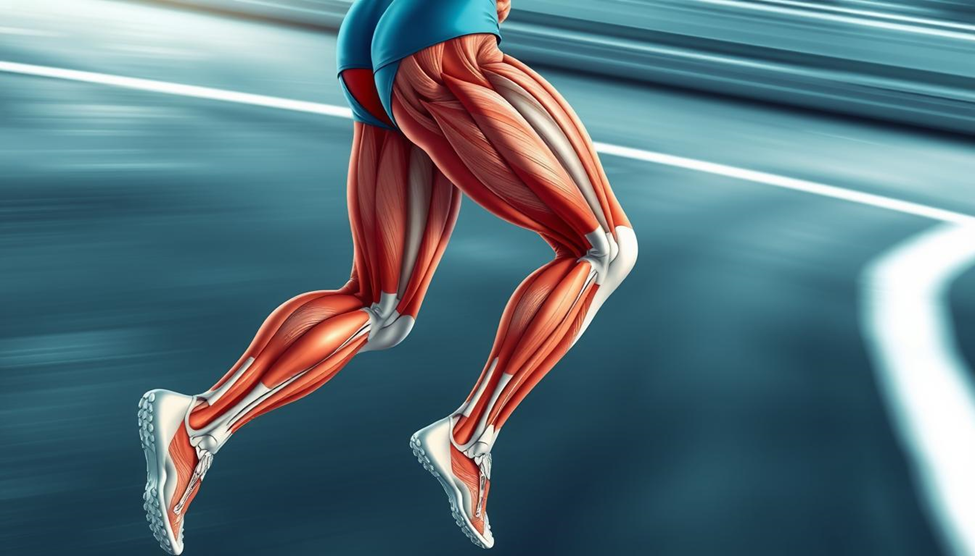
What Muscles Does Running Work: Full Body Benefits
Running is a great cardio exercise that works many muscles in the body. The Centers for Disease Control and Prevention (CDC) say adults should run at least 150 minutes a week<>. This workout strengthens your core, hips, glutes, and legs. It also releases happy hormones, making you feel good<>.
Running is not just good for your body. It also helps you sleep better, lowers depression risk, and makes your bones and muscles stronger<>. Knowing which muscles running targets can help you get the most out of it.
Key Takeaways
- Running engages a wide range of muscles, including the core, hips, glutes, quads, hamstrings, and calves.
- Regular running can lead to muscle growth and improved strength.
- Running offers numerous health benefits, such as better sleep, reduced risk of depression, and increased endurance.
- Understanding the specific muscle groups targeted during running can help you optimize your training for maximum benefits.
- Incorporating strength training exercises can further enhance the muscle-building effects of running.
Understanding How Running Impacts Your Body
Running is a full-body activity that works many muscles and systems. It involves the core, lower limbs, and upper body. Each muscle group plays a key role in moving efficiently and safely<>.
The Science Behind Running Mechanics
The running gait cycle has two phases: stance and swing. During stance, the foot is on the ground, and muscles work to move the body forward and balance. In the swing phase, the foot is lifted, and muscles prepare for the next step<>.
Phases of Running Gait
- Stance Phase: The foot is on the ground, engaging muscles for stability, power, and shock absorption<>.
- Swing Phase: The foot is lifted, and muscles like the hip flexors and quadriceps swing the leg forward<>.
Impact on Muscle Development
Running can grow muscles in the lower body. Faster runs and hill workouts can strengthen legs, hips, and core. But, running mainly improves cardiovascular health, not muscle growth as much as strength training<>.
|------------------|------------------------------------------------------------------------------------------------------------------------------------------------------------| | Muscle Group | Role in Running | | Core | Provides stability, balance, and shock absorption during running<>. | | Hip Flexors | Help with leg swing and forward propulsion, but tight hip flexors can lead to compensations in other muscle groups<>. | | Glutes | Play a key role in propelling forward movement and maintaining torso stability during running<>. | | Quadriceps | Extend the knee and transfer energy to the hamstrings during running<>. | | Hamstrings | Assist with hip extension, knee flexion, and maintain knee stabilization while running. Weak hamstrings compared to quadriceps may result in imbalances<>. | | Calves | Essential for pushing off the ground, balance, and shock absorption during running<>. |
""Running is a full-body exercise that engages a wide range of muscles, from the core to the lower limbs. Understanding the biomechanics and muscle activation patterns is crucial for optimizing running performance and preventing injuries.""
What Muscles Does Running Work
Running works many muscles across the body. The leg muscles during running are especially important. They focus on the core, hips, and lower body<>. Professional sprinters see better performance with muscle building, as shown in a 2020 British Sports Journal report<>.
Strength training for 6--20 weeks can improve running by up to 8% for distance runners<>.
The running muscle groups include the core, hip flexors, glutes, and more<>. A 2017 study found that running can increase muscle size, especially in the quads<>. The arms, shoulders, chest, and upper back also help with running form<>.
How much each muscle works can change based on speed and terrain<>. Running works muscles like glutes and quads, as seen in Exercise and Sport Sciences Reviews<>. A mix of HIIT, speed training, and rest is key for building muscle while running<>.
|-------------------------------------------------|---------------------------------------------------------------| | Muscle Group | Role in Running | | Core (Abdominals and Obliques) | Stabilizes the torso and maintains proper posture | | Hip Flexors | Responsible for lifting the leg during the swing phase | | Glutes | Provide power and propulsion during the push-off phase | | Quadriceps | Extend the knee and provide stability during the stance phase | | Hamstrings | Flex the knee and decelerate the leg during the swing phase | | Calves | Generate power and propulsion during the push-off phase | | Upper Body (Arms, Shoulders, Chest, Upper Back) | Maintain proper running form and posture |
To build muscle while running, balance is key. This means mixing cardio, strength training, and rest<>. Aim for 30-40 minutes of cardio, four to five times a week, at 70-80% heart rate reserve<>.
Core Muscles: Your Running Foundation
As a runner, your core muscles are key to your performance and injury prevention. They are in your midsection, connecting your upper and lower body. They provide stability and strength with every step<>.
Transverse Abdominis Benefits
The transverse abdominis is a major core muscle. It stabilizes your spine and pelvis, reducing injury risk<>. Engaging this muscle improves your running efficiency, helping you stay in good form and save energy.
Obliques and Stability
The obliques, on your core's sides, are also vital for stability during runs<>. Strengthening them reduces wobbling and boosts overall stability. This is crucial for speed workouts and hill runs.
Core Engagement Techniques
Engaging your core during runs is key for good posture and injury prevention. Exercises like the dead bug target the transverse abdominis and obliques. They help build the strength and stability needed for safe and efficient running<><>.
Adding core-strengthening exercises to your training can greatly improve your running<><>. A strong core is the base for powerful, efficient, and injury-free running.
""Maintaining proper posture through core strength is essential for running economy and injury prevention.""
Hip Flexors and Their Role in Running
As a runner, knowing how your hip flexor muscles work is key. These muscles are at the front of your hips. They help move your knee up towards your shoulders<>.
Hip flexors are key for walking and quick movements in sports. Their strength affects how well you run. This includes how your legs move forward and backward<>.
Runners with stiff legs and high kicks might need stronger hip flexors<>. To get stronger, try lunges, knee raises, and running drills. Isometric holds and eccentric movements also help train these muscles<>.
Keeping your hip flexors strong is vital for running stability<>. Weak hip flexors can lead to injuries and affect older adults' mobility<>. Strengthening them is key for running fast<>.
|-----------------------|------------------------------------------------------------------------------------------------------------------------------------------------------| | Study | Findings | | Ikezoe et al. (2021) | Weak hip flexor strength predicts progression of functional capacity decline due to locomotor system dysfunction in community-dwelling older adults. | | Luedke et al. (2015) | Isometric strength of hip and knee muscles is associated with injury risk in high school cross country runners. | | Niemuth et al. (2005) | Hip muscle weakness is linked to overuse injuries in recreational runners. | | Silva et al. (2018) | Hip muscular strength balance correlates with running economy in recreationally-trained endurance runners. |
In summary, hip flexors are vital for runners. They help with hip movement and running form. Working on these muscles can boost your running and lower injury risk<><>.
Glutes: The Powerhouse of Running
As a runner, your gluteal muscles are key to moving your body forward. The gluteus maximus, the biggest muscle in our body<>, helps extend the hip and push you off the ground. The gluteus medius and minimus muscles keep the pelvis stable and control how your weight shifts while running<>.
Weak glutes can cause problems like knee pain, IT band syndrome, and lower back issues<>. But strong glutes boost endurance, make running more efficient, and lower injury risks<>.
Strengthening Exercises for Powerful Glutes
To build strong glutes, add these exercises to your routine:
- Step-ups: This targets the gluteus maximus and medius, boosting hip and leg strength<>.
- Hip Thrusts: Focuses on the gluteus maximus, increasing power for running<>.
- Side Planks: Works the gluteus medius and minimus, improving stability and weight shifting<>.
Do these exercises for 30 to 60 seconds each, with little rest in between. Focus on proper form and controlled movements<>. Doing these exercises two times a week can improve performance and prevent injuries<>.
""Strong glutes are the foundation for efficient, injury-free running. Prioritizing glute activation and strength is a game-changer for any runner looking to take their performance to the next level."" - Monique LeBrun, Associate Health and Fitness Editor<>
|--------------|---------------------------------|---------------------------------------------------| | Exercise | Muscles Targeted | Benefits | | Step-ups | Gluteus Maximus, Gluteus Medius | Improved hip and leg strength, enhanced stability | | Hip Thrusts | Gluteus Maximus | Increased power generation during running | | Side Planks | Gluteus Medius, Gluteus Minimus | Better weight shifting and pelvic stability |
By adding these exercises to your training, you can unlock your running muscles' true power<>. Regular work on your glutes will boost endurance, speed, and prevent injuries<>.
Quadriceps and Running Performance
The quadriceps are four muscles in the front of the thigh. They help bend and extend the knee. They also stabilize the leg and provide power for push-off<>.
Strong quadriceps muscles improve endurance and reduce fatigue. They also lower the risk of injuries like runner's knee<>.
Exercises like squats and single-leg movements strengthen the quadriceps <>. Having balanced quad strength helps maintain proper running form<>.
But, it's important to avoid quad dominance . This is common among runners, especially those who suddenly increase their mileage or spend a lot of time sitting<>. Quad dominance can lead to weak glutes and hamstrings, causing injuries and reducing performance<>.
To fight quad dominance , do exercises that target glutes and hamstrings. Deadlifts, rack pulls, and glute bridges are good options<>. Also, foam rolling and stretching can help prevent injuries<>.
|------------------|------------------------------------| | Muscle Group | Strength Range (x Body Weight) | | Glute Max | 1.5 -- 2.8x | | Glute Med | 2.6 -- 3.5x | | Hamstrings | 2.1 -- 9x | | Quadriceps | 4 -- 6x | | Gastroc | 2.5 -- 3x | | Soleus | 6.5 -- 8x |
Understanding the quadriceps and muscle imbalances is key. Runners can improve their performance and lower injury risk by doing so<><><>.
Hamstrings: Essential Running Muscles
The hamstring muscles are key for power in running. They work with the quadriceps to bend the knee and extend the hip. This helps push the body forward<>. Having strong, flexible hamstrings is vital for good running form and injury prevention<>.
Power Generation
Hamstring muscles contract in the late swing and stance phases of running. They play a big role in moving the body forward<>. Research shows that hamstrings can generate up to 8.95 times a runner's body weight in force at 8.9m/second<>. This highlights the need for strong hamstrings for better running.
Injury Prevention
Hamstring strains are common in runners, making up 12-24% of all sports injuries<>. These injuries often happen during fast running, especially in the late swing and stance phases<>. Adding hamstring strengthening exercises to your routine can lower the risk of these injuries.
Training Tips
To strengthen and stretch hamstrings, runners should try different exercises<>. Good ones include single-leg Romanian deadlifts, prone hamstring curls, and the Nordic hamstring exercise. These can cut hamstring injury risk by up to 51%<>. Squats and deadlifts also work the hamstrings. Stretching and foam rolling keep hamstrings flexible and mobile.
By focusing on hamstring development, runners can boost their power, running efficiency, and lower injury risk<><><>.
Calf Muscles and Push-Off Power
As a runner, knowing how your calf muscles work is key for top performance and avoiding injuries. The gastrocnemius and soleus muscles in your calf are vital for the push-off motion in running. They help with speed and climbing hills<>.
The soleus muscle is especially important when your knee bends. It gives steady force and stability, which is great for long runs<>. Strong calf muscles help your stride feel smooth, absorbing shock and pushing you forward<>.
But, calf injuries like strains and Achilles tendinitis are common in runners<>. To avoid these, focus on strengthening your calf muscles with exercises like calf raises and eccentric heel drops . Also, choose the right shoes, gradually increase your training, and rest well<>.
By caring for your calf muscles, you can run better, avoid injuries, and feel more comfortable<>.
|-----------------|--------------------------------------------------|------------------------------------------------------------------------------------------------------| | Muscle | Function | Importance in Running | | Gastrocnemius | Knee flexion and ankle plantar flexion | Crucial for the dynamic push-off motion, aiding in acceleration and uphill running<>. | | Soleus | Ankle plantar flexion, especially with knee bent | Offers sustained force and stability, beneficial for endurance and long-distance running<>. | | Achilles Tendon | Connects the calf muscles to the heel bone | Forms a crucial system with the calf muscles, transmitting their force to the foot during running<>. |
Other muscles like the quadriceps , hamstrings , and gluteal muscles also matter for running. They help with power, stability, and moving well<><>.
Knowing about your calf muscles helps you train and recover better. This leads to better running, fewer injuries, and more fun<>.
""Strengthening the calf muscles through targeted exercises is essential for runners, as these muscles are the primary drivers of the push-off phase, which is crucial for acceleration and uphill running.""
Upper Body Engagement During Running
Running mainly works the lower body, but the upper body is key for balance, posture, and efficiency<>. The arms, shoulders, chest, and back muscles help with good running form<>. Strengthening these muscles can make you run faster, shaving off seconds or minutes from your times<>.
Arm Movement and Balance
Right arm movement is vital for balance and stability while running<>. A strong core and back can lower injury risks, protecting your joints and spine from running's impact<>. Better upper body strength helps keep energy flowing, making your run more efficient<>.
Posture and Form
Good posture is essential for better breathing and running efficiency<>. Strong upper body muscles help keep your body stable, reducing injury risks like ITB or runner's knee<>. Adding resistance training, like using bands or weights, can work more muscles and speed up strength gains<>.
By focusing on upper body during running, you can boost your performance and lower injury risks<>. Always talk to a specialist before starting any workout to make sure it's safe and works well for you<>.
""Engaging the core in running is recommended for stability rather than actively contracting the muscles or using cues that might restrict movement and inhibit breathing.""<>
Hill Running and Muscle Activation
Running on hills works your muscles in a unique way compared to flat ground. When you run uphill, your leg muscles, especially the quadriceps, work harder to fight gravity<>. This effort requires a mid- or forefoot strike, which puts more stress on your calves and ankles<>.
Running downhill, on the other hand, puts more stress on your hip extensors, quadriceps, and knees as you try to slow down<>. Downhill running often involves a heel strike, which helps absorb shock<>. Yet, maintaining proper running form is key for both uphill and downhill to avoid injuries and stay efficient<>.
Uphill running increases activity in the quads, calf, glute max, and hamstrings during the propulsive phase, <> while also tending to increase the load on the Achilles tendon and tibia but decrease it on the patellofemoral joint<>. Downhill running, on the other hand, tends to increase patellofemoral joint stress but reduce peak Achilles load. <>
It's important to note that individual responses to uphill and downhill running can vary based on speed, gradient, step rate, and technique<>. Gait analysis can help identify the specific muscular demands and tailor strategies for hill runners<>.
""Running on hills is a form of resistance training that builds muscle in calves, quads, hamstrings, and glutes. Hill running strengthens muscles more than running on flat surfaces, especially in the calves, quads, hamstrings, and glutes.""<>
Adding hill workouts to your routine can improve your running performance and muscle growth